

Key topics
Related public pages
If you need the product, API or operations page rather than only the article, start with these VPOS.am sections.
Marketplace should separate order, payment and vendor ledger
One order can include several sellers, commissions, delivery and different refund rules.
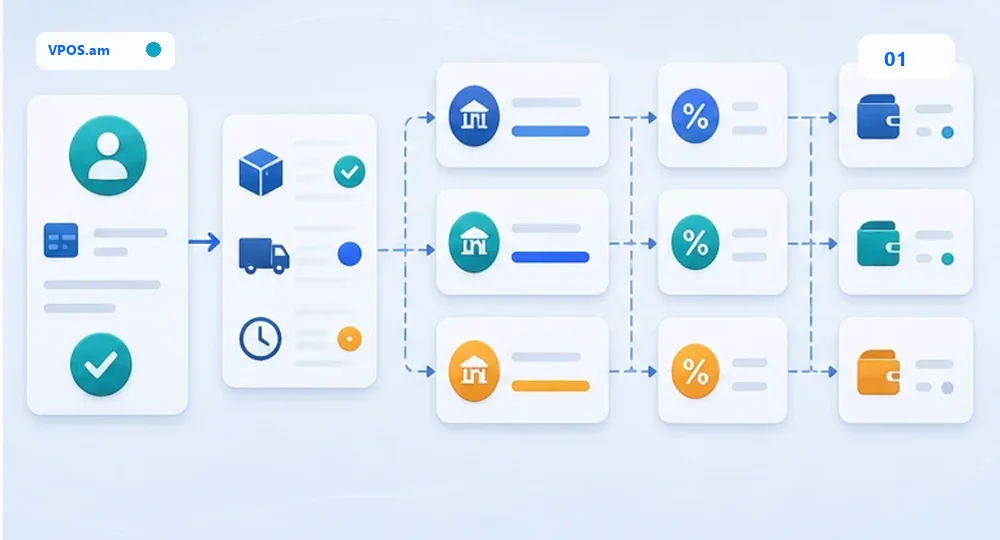
In a regular online store, one order often belongs to one seller. In marketplace and multivendor scenarios, one payment can relate to several sellers, products, commissions, delivery, discounts and partial refunds. If the system stores only paid/failed, financial picture breaks quickly.
Reliable model separates customer order, payment intent, provider reference, vendor ledger and business settlement. Payment backend stores payment and events, while ledger shows which part of amount belongs to seller, platform fee, delivery and refunds.
- connect payment id with order id and vendor ids;
- store commission rule version at payment time;
- separate gross amount, platform fee and vendor share;
- do not use one paid status as seller reporting.
Split, payouts and settlement need explicit rules
Automatic transfers depend on provider, contract and legal model, so settlement workflow should come first.

Teams often call this split payment immediately, but technically and legally it can be a different process: one merchant payment, internal ledger, manual or batch seller settlement, accounting export or separate payout integration. Automatic payouts should not be promised if provider and contract do not support them.
Practical start is controlled settlement workflow: vendor balance, payout period, refund hold, commission rule, manual review and accounting export. When bank or provider confirms available payout mechanism, workflow can be automated without losing audit trail.
- do not mix customer payment and seller payout;
- store payout period and settlement status;
- account for refund hold before seller payout;
- log manual approval and exported accounting file.
Refunds and disputes should recalculate ledger
Partial refund for one seller should not break reporting for other sellers and platform commission.

Marketplace refund is rarely simple. Customer can return one item from order, seller can accept partial refund, delivery can remain paid and platform commission can be recalculated by a separate rule. All of this should be visible before period close.
Ledger should store original payment, refund amount, affected vendor, commission adjustment, dispute status and provider reference. Support sees not only refund amount, but its effect on seller, platform, delivery and reporting.
- partial refund should point to affected vendor line;
- dispute is not the same as normal refund;
- commission adjustment is stored as separate event;
- reconcile provider report, vendor ledger and ERP export.
FAQ
Can split payment between sellers be launched immediately?
It depends on provider, contract and legal model. Without confirmed mechanism, safer start is customer payment, vendor ledger and controlled settlement workflow.
How should platform commission be recorded?
Store commission rule version at payment time and calculate separate ledger lines: gross amount, platform fee, vendor share, delivery and adjustments.
What happens during partial refund?
Refund should point to a specific vendor/order line, recalculate commission adjustment and remain visible in payment history, ledger and ERP export.